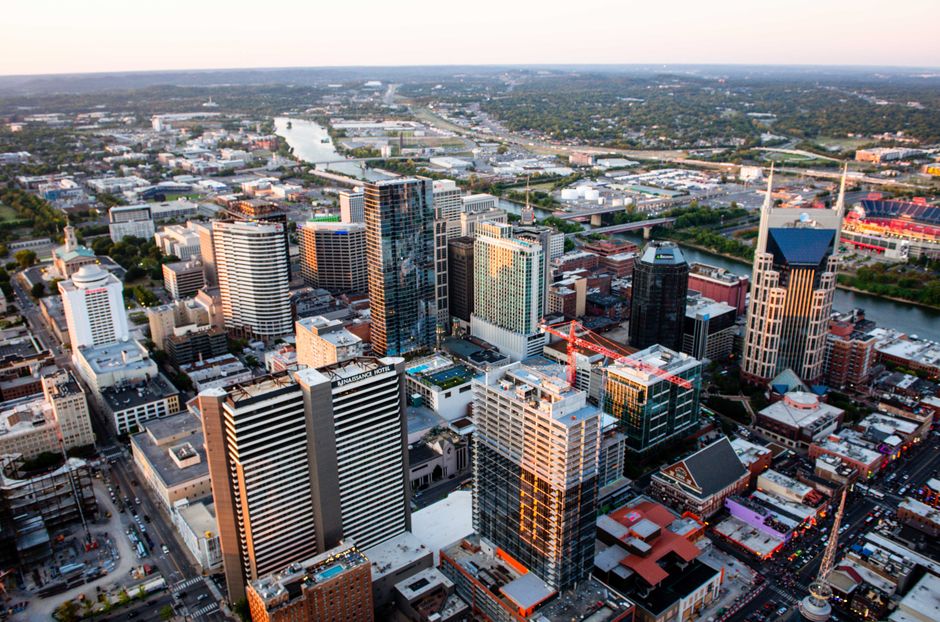
What Nashville's 3.5% Retail Vacancy Means for Buyers
NASHVILLE — On a Thursday in late September, a Lower Broadway building that has poured beer and pizza to honky-tonk crowds since 2005 quietly went up for sale. The Mellow Mushroom space, listed on Sept. 25, 2026 per the Nashville Business Journal, last changed hands for $450,000 two decades ago — a number that reads like a relic in a city where a single well-placed storefront now anchors an entire investment thesis.
That listing arrived the same week a Nevada limited-liability company tied to The Boring Company recorded a $7 million commercial purchase along Murfreesboro Pike, according to WSMV, its deed stamped Sept. 17, 2026. The two transactions bracket the range of Nashville's current commercial appetite — from a downtown block to a tunnel-route gamble — and together they explain why searches for Nashville commercial real estate for sale have surged into 2026.
The thesis for anyone shopping this market is simple to state and hard to execute: demand is real, but it varies sharply by property type, and how you intend to use a building matters as much as where it sits.
Start with the tailwind everyone cites. Nashville ranked No. 1 for desirability in Clever's 2026 city analysis and tied for No. 9 on LendingTree's 2026 boomtown list, The Tennessean reported on Sept. 27, 2026; LendingTree measured 3.2% workforce growth and 3.7% real GDP growth from 2023 to 2024. Tourism amplifies it — Davidson County visitors generated a record $11.6 billion in spending in 2025, up 3.5% from the prior year, according to Visit Music City, accounting for more than a third of statewide visitor dollars.
Those crowds land hardest on retail, where scarcity now defines the math. Matthews Real Estate Investment Services reported Nashville retail vacancy at just 3.5% in the second quarter of 2026, with asking rents of $31.07 per square foot and 5.2% annual rent growth. For a small-business owner hoping to buy rather than lease in an established corridor, the popularity is already priced into the room.
Other sectors tell different stories. Colliers reported 526,000 square feet of positive office absorption in Q2 2026 and vacancy easing for a fourth straight quarter to 18.2% — a recovery concentrated in newer, better-located buildings rather than the market as a whole. Industrial remains the steadier bet; CBRE logged 1.8 million square feet of net absorption in Q2 2026 against 4.8% vacancy and average asking rents of $10.14 per square foot, though 8.6 million square feet under construction signals supply is normalizing.
The growth is also migrating outward. Thompson Thrift announced The Statesman, a 340-unit project in Gallatin, according to Multi-Housing News, while Dickson recorded 49 residential closings in May 2026, up from 35 a year earlier, WKRN reported. Downtown, meanwhile, added 24,700 housing units from 2020 to 2025 — the most of any U.S. downtown in an Urban Institute study cited by the Nashville Business Journal — even as the city still projects a 20,000-unit shortage over the coming decade. Those rooftops feed daily demand for the clinics, cafes and neighborhood retail that commercial buyers underwrite.
Financing is where use collides with strategy. The U.S. Small Business Administration's 504 program offers long-term fixed-rate financing up to $5.5 million for owner-occupied buildings, land and renovation — but not for speculative rental property. And as of July 2026, the SBA raised the combined 7(a) and 504 limit to $10 million for eligible borrowers, widening the runway for capital-intensive small businesses.
Which returns the question to that empty Broadway building and the pike-side parcel bought by a tunnel company. In Nashville, the price of entry is no longer the hard part; knowing exactly what you plan to do with the square footage is.